Unlocking the history of your Ford tractor is simpler than you might think. Those seemingly random numbers stamped onto your machine are, in fact, a comprehensive code revealing not just its age, but also its unique features and even the impact of historical events on its production. This guide will equip you with the knowledge to decipher this code, whether you're a seasoned collector, a restoration expert, or simply curious about your tractor's past. Let's embark on this journey through time, exploring the fascinating evolution of Ford tractor identification systems. For more detailed specifications, check out this helpful Ford Tractor Specs resource.
Deciphering the Clues: A Historical Overview
The methods used to identify Ford tractors evolved significantly over time, reflecting advancements in manufacturing techniques and record-keeping. Early methods were rudimentary, offering only general production windows, while later systems provided far more precise dates. Understanding this evolution is crucial to accurately dating your tractor.
Early Days: Hand-Stamped Simplicity (Pre-1960s)
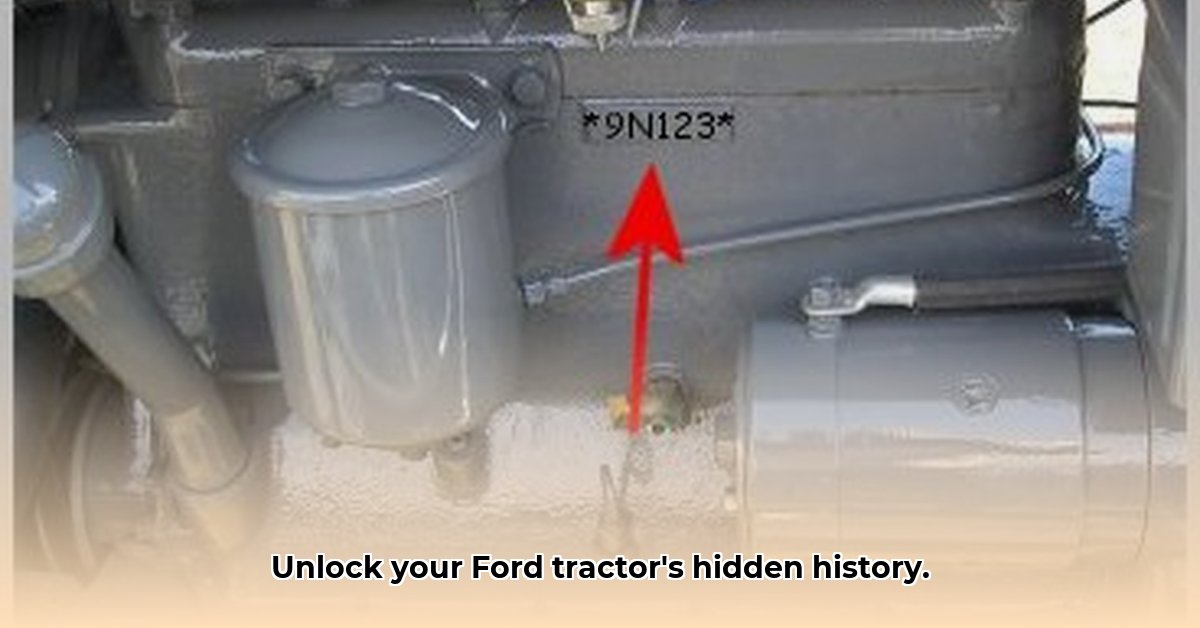
Early Ford tractors, like the iconic 9N, relied on hand-stamped engine numbers as their primary identifier. These numbers provided a rough estimate of the production year, reflecting the simpler manufacturing practices of that era. This method, while less precise than later systems, offers a unique glimpse into the early days of Ford tractor production. It's akin to comparing a handwritten letter to a modern email – one offers a personal touch, while the other prioritizes efficiency. However, even within this seemingly simple system, inconsistencies and variations can be found, adding to the puzzle. How many Ford tractors were manufactured during this early phase? The answer, while not precisely documented, highlights the less industrialized process involved.
The Rise of Serial Numbers and Casting Dates
As Ford's manufacturing processes advanced, so did its identification systems. Models like the NAA introduced serial numbers etched onto the transmission housing, providing a more precise way to track individual tractors. These numbers, coupled with casting date codes stamped on individual components (which might be weeks or months apart from the final assembly date), allow for a more detailed chronological history. The addition of model variations—each reflected in the assigned number—further increased complexity, mirroring the broadening range of equipment available to farmers.
The NAA and Beyond: Refinements in Identification
The NAA model, launched in 1952 to celebrate Ford's 50th anniversary, stands as a significant milestone. Referred to as the "Red Tiger" for its powerful engine, the NAA marked a shift towards more sophisticated serial number systems. The subsequent Hundred Series and 01 Series tractors further refined these identification methods, providing greater detail and increasing the complexity of the decoding process.
The Impact of World War II: A Disruption in Production
World War II significantly impacted Ford's production capabilities. The demand for war materials resulted in material shortages, forcing changes in manufacturing processes and models. The 9N's production, for example, was temporarily halted in 1942. The resulting simpler 2N model, built with readily available materials, reflects this wartime disruption. The numbers and variations in components from this era carry a powerful story of adaptation and resilience. Did you know that the simplified design of the 2N was a direct response to the war's limitations? This reveals the profound influence of global events on even seemingly mundane items like farm machinery.
Dating Your Ford Tractor: A Step-by-Step Guide
Accurately dating your Ford tractor requires a systematic approach, combining the information from the main serial number with the casting date codes found on individual components.
Step 1: Locate the Serial Number: The location varies depending on the model. It's often found on the engine block (older models) or the transmission housing (newer models).
Step 2: Identify Casting Dates: Examine various components for casting dates. These codes, usually stamped onto parts, reveal their manufacturing dates. Remember, these can differ significantly from the final assembly date.
Step 3: Cross-Reference Your Findings: Utilize online databases, specialized tractor manuals, and online communities dedicated to Ford tractors to match your findings and further refine your date estimate. Many resources offer decoding charts and production timelines.
Step 4: Consider Variations: Keep in mind that variations in coding practices exist across different model years and production runs. Thorough research and cross-referencing are essential.
Key Differences: A Model Comparison
| Model | Serial Number Location | Approximate Production Period | Engine Type | Key Features |
|---|---|---|---|---|
| 9N | Engine Block | Pre-World War II | Standard | Simple Design, Iconic Status |
| 2N | Engine Block | World War II Era | Standard (Simplified) | Wartime Production, Limited Features |
| NAA | Transmission Housing | Post-World War II | "Red Tiger" Overhead Valve | More Powerful, Advanced Technology |
The journey of unearthing your Ford tractor's history isn't merely about finding a date; it's about connecting with its unique past and appreciating the craftsmanship and innovation behind its creation. Each number holds a piece of its story, reflecting a legacy of hard work, resourcefulness, and the enduring impact of Ford tractors on agriculture.